UNIST site map
- Admissions
-
Academics
- Colleges and Schools
-
Academic Affairs
- Academic Calendar
- Academic Curriculum
- Requirements for Graduation
- Browse Open Courses
- Undergraduate Administration
-
Graduate Academic Affairs
- Tuition Fee Payment
- Academic Leave of Absence/ Academic Return
- Voluntary Withdrawal/ Expulsion
- Change of Major
- Change of Degree Program/ Dropping of Degree Program
- Class Period/ Attendance Period/ Academic Year・Semester
- Course Registration
- Course Drop
- Attendance/ Grade/ Exam
- Credit Transfer/ Credit Carryover
- Academic Forms
- Education Support
-
Research/Industry
- Research Aims
- Research Findings
- Researcher Search
-
Research Organizations
- UNIST Multi-Interdisciplinary Institute
- IBS Research Groups
-
UNIST Labs
- Department of Mechanical Engineering
- School of Energy and Chemical Engineering
- Department of Civil
- Department of Materials Science and Engineering
- Department of Nuclear Engineering
- Department of Industrial Engineering
- Department of Design
- Department of Biomedical Engineering
- Department of Biological Sciences
- Department of Electrical Engineering
- Department of Computer Science and Engineering
- Department of Mathematical Sciences
- Department of Chemistry
- Department of Physics
- School of Business Administration
- Graduate School of Carbon Neutrality
- Graduate School of Artificial Intelligence
- Research Support
- University-Industry Relations
- Campus Life
- News Center
- About UNIST
-
etc
- UNIST Bulletin
- Work-Life Balance Support System
- UNIST Gender Equality Plan
- Faculty Invitation for Tenure Track
- Faculty Invitation for Non-Tenure Track
- Board Meeting Minutes
- University Council Meeting Minutes
- Administrative Service Charter
- Privacy Policy
- Copyright Policy
- Rejection of Unauthorized Email Collection
- Operation and Management Policy for Video Information Processing Devices
- Information Disclosure


Connection Points of Knowledge, Everything About UNIST
Try searching.
Recommended search terms


- portal
- U Academics Innovation Center
- Leadership Center
- Dormitory
- Academic Information Center
- International Students Support
- Browse Open Courses
- Course Registration
- Graduation Requirements for Graduation
- Academic Leave of Absence/ Academic Return
- Military Service
- Certificate Issuance
- Academic Calendar
- Scholarships
- Campus Map
- Campus Life Guidebook
- Health Care Center
- Human Rights Center
- portal
- Job Opening
- Announcement for Bid
- UNIST AI Services
- UNIST Daycare Center
- Sports Center
- UI Downloads
- Announcement
- Recruitment of Professors (Non-tenure)
- Faculty Invitation for Tenure Track
- UNIST Academic Information Center
- Office of Research Facilities and Training
- Office of Research Affairs
- Rule Management System
- Academic Calendar


This is a collection of menus necessary for UNIST students .
students
- portal
- U Academics Innovation Center
- Leadership Center
- Dormitory
- Academic Information Center
- International Students Support
- Browse Open Courses
- Course Registration
- Graduation Requirements for Graduation
- Academic Leave of Absence/ Academic Return
- Military Service
- Certificate Issuance
- Academic Calendar
- Scholarships
- Campus Map
- Campus Life Guidebook
- Health Care Center
- Human Rights Center


This is a collection of menus necessary for prospective UNIST Students .
prospective Students


This is a collection of menus necessary for UNIST Faculty & Staff .
Faculty & Staff
- portal
- Job Opening
- Announcement for Bid
- UNIST AI Services
- UNIST Daycare Center
- Sports Center
- UI Downloads
- Announcement
- Recruitment of Professors (Non-tenure)
- Faculty Invitation for Tenure Track
- UNIST Academic Information Center
- Office of Research Facilities and Training
- Office of Research Affairs
- Rule Management System
- Academic Calendar


NEWS CENTER
Discover not only Research Findings and event news, but also the diverse facets of UNIST presented by reporters and writers.
News Center

UNIST News
New High-Efficiency Wireless Charging for Implantable Medical Devices
Their findings have been published in IEEE TVLSI on April 29, 2026.
- Research
- JooHyeon Heo
- 2026.06.04
- 954
Abstract
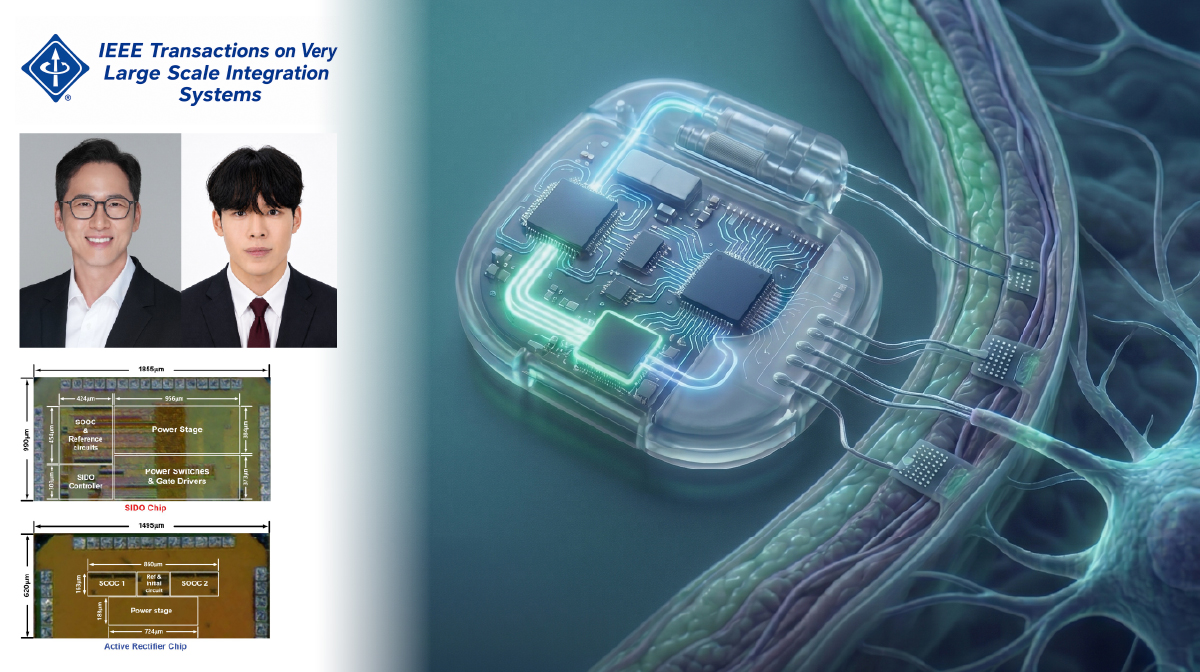
A new wireless charging technology promises to enhance the safety and longevity of implantable medical devices, such as pacemakers and neural stimulators. Led by Professor Franklin Bien of the Department of Electrical Engineering, the research team developed a system that employs load-specific matching networks and adaptive control to optimize power delivery.
Implantable devices often incorporate circuits with varying power demands—high-current circuits for stimulation and low-current circuits for data processing. Traditional wireless chargers rely on fixed configurations, which can lead to inefficiencies and heat buildup, potentially damaging surrounding tissue. The new system detects changes in load and switches between dedicated matching networks tailored for high and low power conditions, thereby optimizing energy transfer.
Furthermore, the team improved the efficiency of the rectifier circuit that converts received alternating current (AC) into direct current (DC). By precisely controlling switching points during power conversion, they minimized energy loss and enhanced overall performance.
Experimental results demonstrated a link efficiency of 94.4% at a low load of 3mA and 92.7% at a high load of 30mA. The active rectifier achieved a peak power conversion efficiency of up to 94.5%, maintaining above 92% even as input voltage varied from 2.5V to 5V.
The research team anticipates that this technology will extend the operational lifespan of implantable devices, reducing the need for frequent surgical replacements and associated risks. It also holds promise for application in wearable electronics and compact Internet of Things (IoT) devices that require reliable, low-loss wireless power.
The findings of this research were published online in the IEEE Transactions on Very Large Scale Integration (VLSI) Systems on April 29, 2026. The study has been s upported by the Ministry of Science and ICT (MSIT) and the Institute for Information & Communications Technology Planning & Evaluation (IITP).
Journal Reference
Sungmin Shin, Seongbin Kwon, Geonwoo Baek, et al ., “A Single-Input Dual-Output Wireless Power Transfer System With Load-Optimized Matching Network,” IEEE TVLSI. , (2026).
Related Links


-
Breakthrough Chameleon MXene Promises Advanced 6G Communication and Next-Gen Batteries
-
Revolutionizing Semiconductor Design: AI Cuts Development Time from Months to Just One Day
-
Revolutionary Reusable MoS₂ RF Biosensor Enables Cost-Effective Liquid Biopsies for Early Cancer Detection
-
New Study Unveils Ultra-Compact, Low-Power Semiconductor Circuit for High-Quality Clock Signals with Minimal Noise