UNIST site map
- Admissions
-
Academics
- Colleges and Schools
-
Academic Affairs
- Academic Calendar
- Academic Curriculum
- Requirements for Graduation
- Browse Open Courses
- Undergraduate Administration
-
Graduate Academic Affairs
- Tuition Fee Payment
- Academic Leave of Absence/ Academic Return
- Voluntary Withdrawal/ Expulsion
- Change of Major
- Change of Degree Program/ Dropping of Degree Program
- Class Period/ Attendance Period/ Academic Year・Semester
- Course Registration
- Course Drop
- Attendance/ Grade/ Exam
- Credit Transfer/ Credit Carryover
- Academic Forms
- Education Support
-
Research/Industry
- Research Aims
- Research Findings
- Researcher Search
-
Research Organizations
- UNIST Multi-Interdisciplinary Institute
- IBS Research Groups
-
UNIST Labs
- Department of Mechanical Engineering
- School of Energy and Chemical Engineering
- Department of Civil
- Department of Materials Science and Engineering
- Department of Nuclear Engineering
- Department of Industrial Engineering
- Department of Design
- Department of Biomedical Engineering
- Department of Biological Sciences
- Department of Electrical Engineering
- Department of Computer Science and Engineering
- Department of Mathematical Sciences
- Department of Chemistry
- Department of Physics
- School of Business Administration
- Graduate School of Carbon Neutrality
- Graduate School of Artificial Intelligence
- Research Support
- University-Industry Relations
- Campus Life
- News Center
- About UNIST
-
etc
- UNIST Bulletin
- Work-Life Balance Support System
- UNIST Gender Equality Plan
- Faculty Invitation for Tenure Track
- Faculty Invitation for Non-Tenure Track
- Board Meeting Minutes
- University Council Meeting Minutes
- Administrative Service Charter
- Privacy Policy
- Copyright Policy
- Rejection of Unauthorized Email Collection
- Operation and Management Policy for Video Information Processing Devices
- Information Disclosure


Connection Points of Knowledge, Everything About UNIST
Try searching.
Recommended search terms


- portal
- U Academics Innovation Center
- Leadership Center
- Dormitory
- Academic Information Center
- International Students Support
- Browse Open Courses
- Course Registration
- Graduation Requirements for Graduation
- Academic Leave of Absence/ Academic Return
- Military Service
- Certificate Issuance
- Academic Calendar
- Scholarships
- Campus Map
- Campus Life Guidebook
- Health Care Center
- Human Rights Center
- portal
- Job Opening
- Announcement for Bid
- UNIST AI Services
- UNIST Daycare Center
- Sports Center
- UI Downloads
- Announcement
- Recruitment of Professors (Non-tenure)
- Faculty Invitation for Tenure Track
- UNIST Academic Information Center
- Office of Research Facilities and Training
- Office of Research Affairs
- Rule Management System
- Academic Calendar


This is a collection of menus necessary for UNIST students .
students
- portal
- U Academics Innovation Center
- Leadership Center
- Dormitory
- Academic Information Center
- International Students Support
- Browse Open Courses
- Course Registration
- Graduation Requirements for Graduation
- Academic Leave of Absence/ Academic Return
- Military Service
- Certificate Issuance
- Academic Calendar
- Scholarships
- Campus Map
- Campus Life Guidebook
- Health Care Center
- Human Rights Center


This is a collection of menus necessary for prospective UNIST Students .
prospective Students


This is a collection of menus necessary for UNIST Faculty & Staff .
Faculty & Staff
- portal
- Job Opening
- Announcement for Bid
- UNIST AI Services
- UNIST Daycare Center
- Sports Center
- UI Downloads
- Announcement
- Recruitment of Professors (Non-tenure)
- Faculty Invitation for Tenure Track
- UNIST Academic Information Center
- Office of Research Facilities and Training
- Office of Research Affairs
- Rule Management System
- Academic Calendar


NEWS CENTER
Discover not only Research Findings and event news, but also the diverse facets of UNIST presented by reporters and writers.
News Center

UNIST News
New Study Unveils High-Purity, Electrically Controlled Single-Photon Source for Quantum Technologies
The findings of this study have been published in the online version of Nano Letters on March 11, 2026.
- Research
- JooHyeon Heo
- 2026.04.08
- 633

Abstract
Researchers at UNIST have developed a novel single-photon emitter (SPE) that can be electrically switched on and off with high purity and stability. This breakthrough addresses key challenges in quantum device engineering, paving the way for scalable quantum computing and secure quantum communication.
Based on a 2D semiconductor integrated with a silicon nanopyramid structure, the device generates single photons with minimal spectral shift during electrical modulation. By engineering a nanoscale air gap, the team effectively suppresses the Stark effect—preventing energy shifts in emitted photons—while maintaining a high level of single-photon purity (g(2)(0) ≈ 0.06). This design also reduces background emissions from defects, enhancing overall performance.
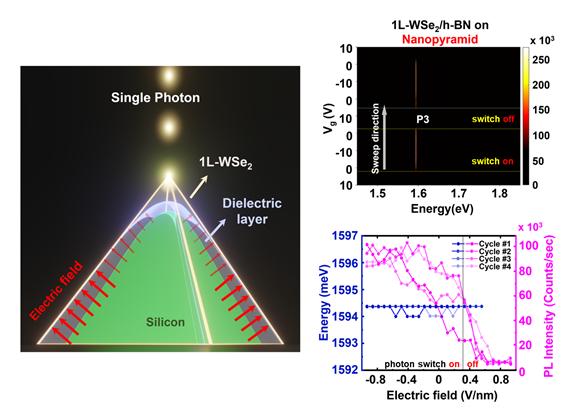
“This work represents a significant step toward integrated quantum photonics,” said the research team. “Controlling single photons electrically without spectral degradation opens new possibilities for scalable quantum devices.”
This study has been participated by Satyabrat Behera and Jong Sung Moon, as first authors of the study. Published in the March 2026 issue of Nano Letters, the research was supported by the IITP (Institute of Information & Communications Technology Planning & Evaluation)-ITRC (Information Technology Research Center) program by the Ministry of Science and ICT (MSIT), the National Research Foundation of Korea (NRF), and UNIST.
Journal Reference
Satyabrat Behera, Jong Sung Moon, Kirlie Iulius Figuera Michal, et al., "Electrical Control of Single Photon Emitters in WSe2 on a Si Nanopyramid Array with a Negligible Stark Effect," Nano Lett., (2026).
Related Links


-
Bright Quantum Light Emission Achieved at Room Temperature in 2D Semiconductors
-
New Study Reveals How Chirality Controls Electron Spin Direction
-
Revolutionary Method Enables Rapid, Eco-Friendly Production of Multi-Metal Nanostructures Using CO2
-
Innovative Light-Responsive Molecule Enables Reversible Cell Death Control Using Visible and UV Light