UNIST site map
- Admissions
-
Academics
- Colleges and Schools
-
Academic Affairs
- Academic Calendar
- Academic Curriculum
- Requirements for Graduation
- Browse Open Courses
- Undergraduate Administration
-
Graduate Academic Affairs
- Tuition Fee Payment
- Academic Leave of Absence/ Academic Return
- Voluntary Withdrawal/ Expulsion
- Change of Major
- Change of Degree Program/ Dropping of Degree Program
- Class Period/ Attendance Period/ Academic Year・Semester
- Course Registration
- Course Drop
- Attendance/ Grade/ Exam
- Credit Transfer/ Credit Carryover
- Academic Forms
- Education Support
-
Research/Industry
- Research Aims
- Research Findings
- Researcher Search
-
Research Organizations
- UNIST Multi-Interdisciplinary Institute
- IBS Research Groups
-
UNIST Labs
- Department of Mechanical Engineering
- School of Energy and Chemical Engineering
- Department of Civil
- Department of Materials Science and Engineering
- Department of Nuclear Engineering
- Department of Industrial Engineering
- Department of Design
- Department of Biomedical Engineering
- Department of Biological Sciences
- Department of Electrical Engineering
- Department of Computer Science and Engineering
- Department of Mathematical Sciences
- Department of Chemistry
- Department of Physics
- School of Business Administration
- Graduate School of Carbon Neutrality
- Graduate School of Artificial Intelligence
- Research Support
- University-Industry Relations
- Campus Life
- News Center
- About UNIST
-
etc
- UNIST Bulletin
- Work-Life Balance Support System
- UNIST Gender Equality Plan
- Faculty Invitation for Tenure Track
- Faculty Invitation for Non-Tenure Track
- Board Meeting Minutes
- University Council Meeting Minutes
- Administrative Service Charter
- Privacy Policy
- Copyright Policy
- Rejection of Unauthorized Email Collection
- Operation and Management Policy for Video Information Processing Devices
- Information Disclosure


Connection Points of Knowledge, Everything About UNIST
Try searching.
Recommended search terms


- portal
- U Academics Innovation Center
- Leadership Center
- Dormitory
- Academic Information Center
- International Students Support
- Browse Open Courses
- Course Registration
- Graduation Requirements for Graduation
- Academic Leave of Absence/ Academic Return
- Military Service
- Certificate Issuance
- Academic Calendar
- Scholarships
- Campus Map
- Campus Life Guidebook
- Health Care Center
- Human Rights Center
- portal
- Job Opening
- Announcement for Bid
- UNIST AI Services
- UNIST Daycare Center
- Sports Center
- UI Downloads
- Announcement
- Recruitment of Professors (Non-tenure)
- Faculty Invitation for Tenure Track
- UNIST Academic Information Center
- Office of Research Facilities and Training
- Office of Research Affairs
- Rule Management System
- Academic Calendar


This is a collection of menus necessary for UNIST students .
students
- portal
- U Academics Innovation Center
- Leadership Center
- Dormitory
- Academic Information Center
- International Students Support
- Browse Open Courses
- Course Registration
- Graduation Requirements for Graduation
- Academic Leave of Absence/ Academic Return
- Military Service
- Certificate Issuance
- Academic Calendar
- Scholarships
- Campus Map
- Campus Life Guidebook
- Health Care Center
- Human Rights Center


This is a collection of menus necessary for prospective UNIST Students .
prospective Students


This is a collection of menus necessary for UNIST Faculty & Staff .
Faculty & Staff
- portal
- Job Opening
- Announcement for Bid
- UNIST AI Services
- UNIST Daycare Center
- Sports Center
- UI Downloads
- Announcement
- Recruitment of Professors (Non-tenure)
- Faculty Invitation for Tenure Track
- UNIST Academic Information Center
- Office of Research Facilities and Training
- Office of Research Affairs
- Rule Management System
- Academic Calendar


NEWS CENTER
Discover not only Research Findings and event news, but also the diverse facets of UNIST presented by reporters and writers.
News Center

UNIST News
New Study Unveils Mussel-Inspired Coating for Rapid Radioactive Surface Decontamination
The findings of this research have been published online in the March 2026 issue of Materials Horizons.
- Research
- JooHyeon Heo
- 2026.04.09
- 787

Abstract
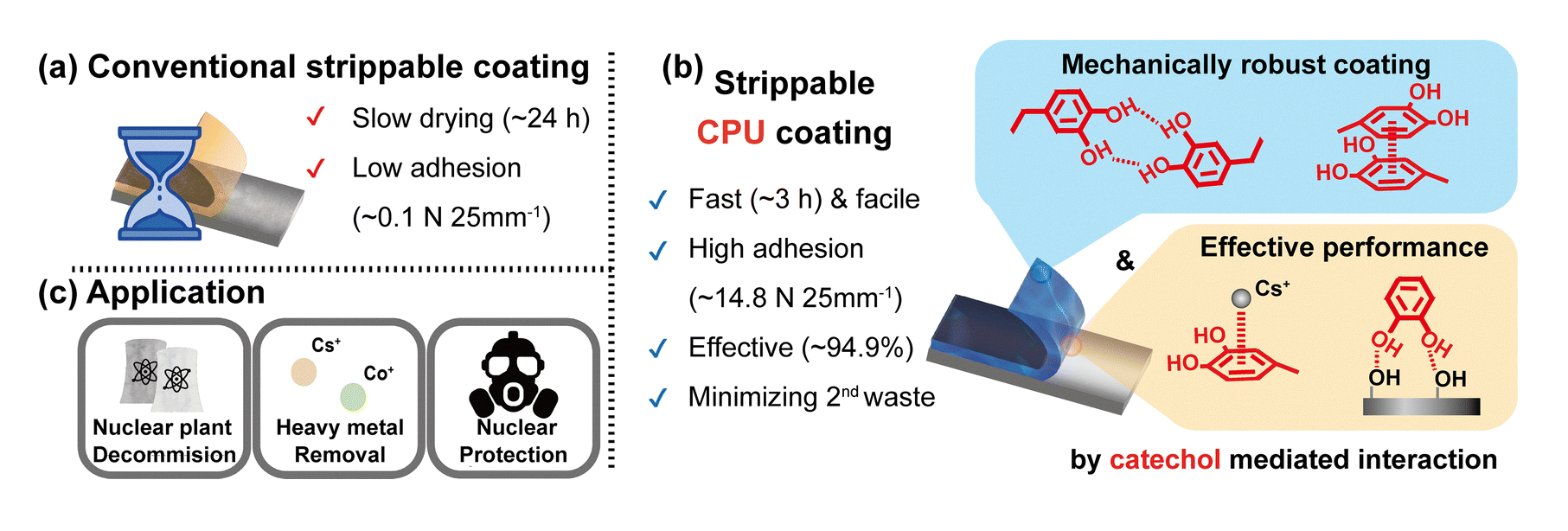
Professor Dong Woog Lee from the School of Energy and Chemical Engineering at UNIST, in collaboration with the Korea Atomic Energy Research Institute (KAERI) have unveiled a novel, mussel-inspired polyurethane coating capable of removing over 95% of radioactive cesium from surfaces in just three hours—far faster than existing methods. This breakthrough promises to enhance safety and efficiency in nuclear decontamination efforts.
The innovative coating utilizes catechol groups—derived from mussel adhesion proteins—attached to polyurethane polymer chains, creating a highly adhesive surface. Applied onto contaminated surfaces, the coating dries within hours and can be peeled off like tape, effectively removing radioactive particles. Laboratory tests demonstrated a cesium removal efficiency of 94.9% on stainless steel and 13.1% on porous cement surfaces after two applications, outperforming commercial products that typically require 24 hours. Additionally, the coating can be dissolved in acetone post-use, enabling waste separation and reducing secondary contamination.
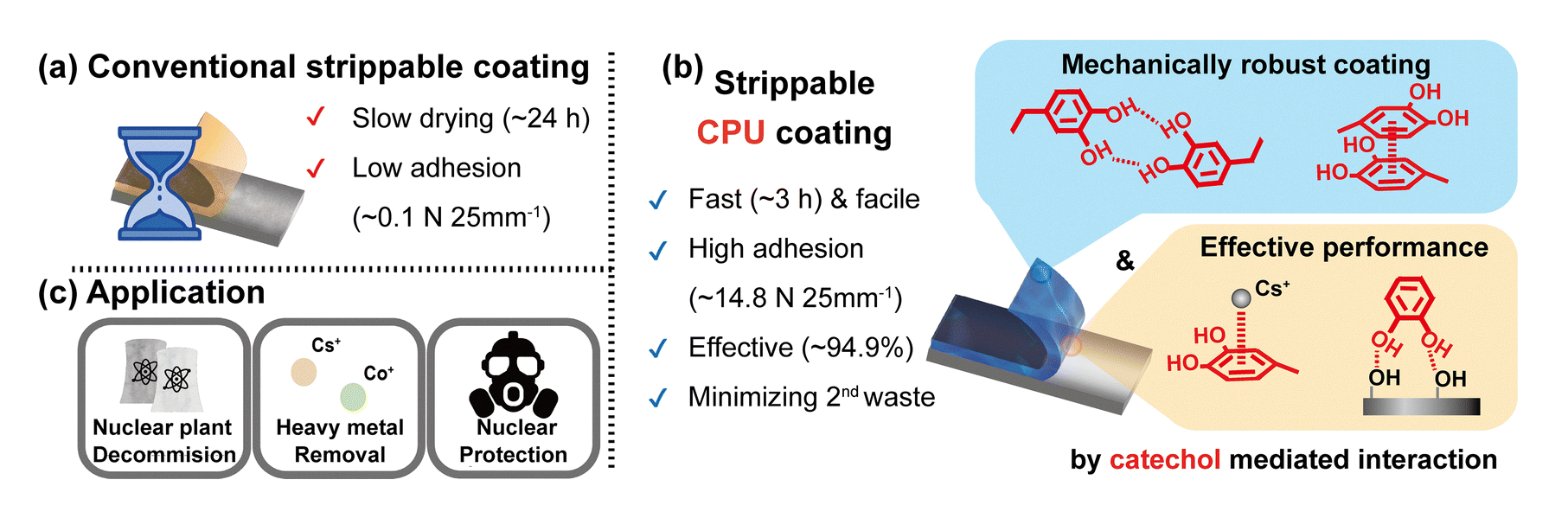
Dr. Heeman Yang, lead researcher from KAERI, stated, “This technology offers a faster, more effective, and environmentally conscious approach to decontamination. Its ability to rapidly remove radioactive materials while facilitating waste management marks a significant advancement in nuclear safety.”
This development addresses critical needs in nuclear facility decontamination, emergency response, and waste reduction. By combining speed, efficiency, and eco-friendliness, the coating holds promise for broad application in nuclear safety and environmental management, contributing to safer decommissioning and accident mitigation in the future.
The findings of this research have been published online in the March 2026 issue of Materials Horizons. The study has been supported by the Institute of Civil Military Technology cooperation, funded by the Defense Acquisition Program Administration and the Ministry of Trade, Industry and Energy (MOTIE).
Journal Reference
Jae Seung Lee, Ye-won Jeong, Donghyun Kim, et al., "A strippable catechol-terminated polyurethane coating for large-area radioactive cesium decontamination," Mater. Horiz., (2026).
Related Links
Related Photo


-
Innovative Scalable Electrochemical Approach for Transforming Waste Glycerol into Hydrogen and High-Value Chemicals
-
Turning Solar Panel Waste into Hydrogen and High-Value Silica
-
Advanced Interface Engineering for High-Performance Solar Cells and Green Hydrogen
-
New Study Unveils Atomic Disorder Strategy to Enhance Stability and Efficiency of High-Capacity Batteries