UNIST site map
- Admissions
-
Academics
- Colleges and Schools
-
Academic Affairs
- Academic Calendar
- Academic Curriculum
- Requirements for Graduation
- Browse Open Courses
- Undergraduate Administration
-
Graduate Academic Affairs
- Tuition Fee Payment
- Academic Leave of Absence/ Academic Return
- Voluntary Withdrawal/ Expulsion
- Change of Major
- Change of Degree Program/ Dropping of Degree Program
- Class Period/ Attendance Period/ Academic Year・Semester
- Course Registration
- Course Drop
- Attendance/ Grade/ Exam
- Credit Transfer/ Credit Carryover
- Academic Forms
- Education Support
-
Research/Industry
- Research Aims
- Research Findings
- Researcher Search
-
Research Organizations
- UNIST Multi-Interdisciplinary Institute
- IBS Research Groups
-
UNIST Labs
- Department of Mechanical Engineering
- School of Energy and Chemical Engineering
- Department of Civil
- Department of Materials Science and Engineering
- Department of Nuclear Engineering
- Department of Industrial Engineering
- Department of Design
- Department of Biomedical Engineering
- Department of Biological Sciences
- Department of Electrical Engineering
- Department of Computer Science and Engineering
- Department of Mathematical Sciences
- Department of Chemistry
- Department of Physics
- School of Business Administration
- Graduate School of Carbon Neutrality
- Graduate School of Artificial Intelligence
- Research Support
- University-Industry Relations
- Campus Life
- News Center
- About UNIST
-
etc
- UNIST Bulletin
- Work-Life Balance Support System
- UNIST Gender Equality Plan
- Faculty Invitation for Tenure Track
- Faculty Invitation for Non-Tenure Track
- Board Meeting Minutes
- University Council Meeting Minutes
- Administrative Service Charter
- Privacy Policy
- Copyright Policy
- Rejection of Unauthorized Email Collection
- Operation and Management Policy for Video Information Processing Devices
- Information Disclosure


Connection Points of Knowledge, Everything About UNIST
Try searching.
Recommended search terms


- portal
- U Academics Innovation Center
- Leadership Center
- Dormitory
- Academic Information Center
- International Students Support
- Browse Open Courses
- Course Registration
- Graduation Requirements for Graduation
- Academic Leave of Absence/ Academic Return
- Military Service
- Certificate Issuance
- Academic Calendar
- Scholarships
- Campus Map
- Campus Life Guidebook
- Health Care Center
- Human Rights Center
- portal
- Job Opening
- Announcement for Bid
- UNIST AI Services
- UNIST Daycare Center
- Sports Center
- UI Downloads
- Announcement
- Recruitment of Professors (Non-tenure)
- Faculty Invitation for Tenure Track
- UNIST Academic Information Center
- Office of Research Facilities and Training
- Office of Research Affairs
- Rule Management System
- Academic Calendar


This is a collection of menus necessary for UNIST students .
students
- portal
- U Academics Innovation Center
- Leadership Center
- Dormitory
- Academic Information Center
- International Students Support
- Browse Open Courses
- Course Registration
- Graduation Requirements for Graduation
- Academic Leave of Absence/ Academic Return
- Military Service
- Certificate Issuance
- Academic Calendar
- Scholarships
- Campus Map
- Campus Life Guidebook
- Health Care Center
- Human Rights Center


This is a collection of menus necessary for prospective UNIST Students .
prospective Students


This is a collection of menus necessary for UNIST Faculty & Staff .
Faculty & Staff
- portal
- Job Opening
- Announcement for Bid
- UNIST AI Services
- UNIST Daycare Center
- Sports Center
- UI Downloads
- Announcement
- Recruitment of Professors (Non-tenure)
- Faculty Invitation for Tenure Track
- UNIST Academic Information Center
- Office of Research Facilities and Training
- Office of Research Affairs
- Rule Management System
- Academic Calendar


NEWS CENTER
Discover not only Research Findings and event news, but also the diverse facets of UNIST presented by reporters and writers.
News Center

UNIST News
New AI Unlearning Method Prevents Forgotten Data from Returning
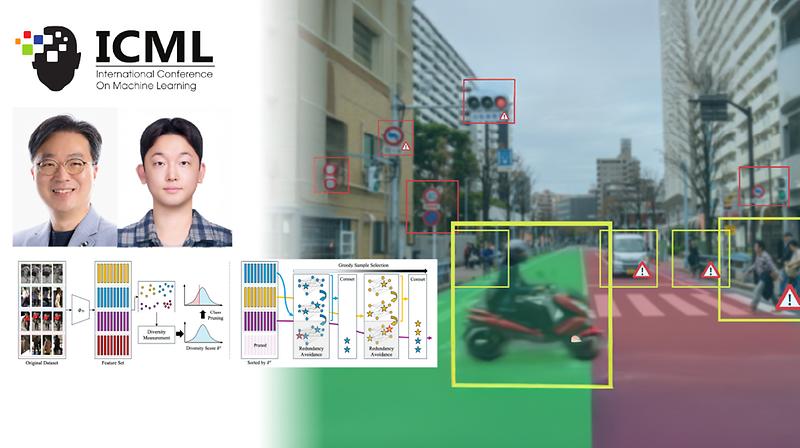
Accepted to ICML 2026, the study addresses two overlooked weaknesses in machine unlearning while preserving information that should remain.
- Research
- JooHyeon Heo
- 2026.07.30
- 5972

Abstract
Machine unlearning (MU) aims to remove sensitive information from trained AI models without costly retraining. Current approaches, however, can forget more than they should—and what has been forgotten can sometimes be learned again.
To address both challenges, a joint research team led by Professor Sung Whan Yoon of the Graduate School of Artificial Intelligence and Professor Saerom Park of the Department of Industrial Engineering developed Spotter , a new MU method that removes targeted information without affecting similar information that should be retained. The method also makes deleted knowledge far from difficult to recover through a relearning attack.
Current MU methods often forget more than intended. Removing one category can unintentionally affect similar categories that were meant to be retained. For example, teaching an AI model to forget cats may also weaken its ability to recognize tigers or leopards.
The team identified a second weakness. Even after information has been removed, a model can recover much of that knowledge from only a handful of examples. In other words, information that was supposed to be forgotten may not stay forgotten.
Spotter addresses both problems at once. It preserves the model's ability to distinguish similar information that should be retained while making deleted knowledge far more difficult to recover. Because it is designed as a plug-and-play method, Spotter can be integrated into existing MU frameworks without extensive modification.
"Machine unlearning has traditionally been evaluated by asking two questions: Has the target information been removed, and does the model still perform well overall?" said SeungBum Ha, the study's first author. "Our work shows those measures do not tell the whole story. Models can still lose information they were supposed to retain—or recover information that was meant to be erased."
In experiments on the CIFAR-10 dataset, Spotter completely removed recognition of the target class, reducing its accuracy to 0%. Even after a relearning attack using just five images, recognition accuracy remained at 0.24%. Under the same attack, existing methods recovered between 71.10% and 99.98% of their original recognition performance. Spotter also maintained 99.96% accuracy on the categories that were meant to be retained.
Spotter performed similarly on the larger TinyImageNet dataset and the real-world face recognition dataset CASIA-WebFace, demonstrating that the method remains effective across different image recognition tasks. These findings suggest Spotter could strengthen AI applications where reliable data removal is essential, including face recognition and identity-level content moderation.
The research was accepted to the International Conference on Machine Learning (ICML) 2026, held in Seoul from July 6 to 11, 2026. The study was supported by the Mid-Career Research Program of the National Research Foundation of Korea (NRF), as well as the Hyper-scale Industrial AI Research Support (R&D) Program, the Artificial Intelligence Graduate School Program at UNIST, the AI Star Fellowship Program, the Innovative Human Resource Development for Local Intellectualization Program, and the Information Technology Research Center (ITRC), supported by the Ministry of Science and ICT (MSIT) and the Institute of Information & Communications Technology Planning & Evaluation (IITP).
Journal Reference
SeungBum Ha, Saerom Park, and Sung Whan Yoon, "Unlearning's Blind Spots: Over-Unlearning and Prototypical Relearning Attack," ICML'26 , (2026).
Related Links