UNIST site map
- Admissions
-
Academics
- Colleges and Schools
-
Academic Affairs
- Academic Calendar
- Academic Curriculum
- Requirements for Graduation
- Browse Open Courses
- Undergraduate Administration
-
Graduate Academic Affairs
- Tuition Fee Payment
- Academic Leave of Absence/ Academic Return
- Voluntary Withdrawal/ Expulsion
- Change of Major
- Change of Degree Program/ Dropping of Degree Program
- Class Period/ Attendance Period/ Academic Year・Semester
- Course Registration
- Course Drop
- Attendance/ Grade/ Exam
- Credit Transfer/ Credit Carryover
- Academic Forms
- Education Support
-
Research/Industry
- Research Aims
- Research Findings
- Researcher Search
-
Research Organizations
- UNIST Multi-Interdisciplinary Institute
- IBS Research Groups
-
UNIST Labs
- Department of Mechanical Engineering
- School of Energy and Chemical Engineering
- Department of Civil
- Department of Materials Science and Engineering
- Department of Nuclear Engineering
- Department of Industrial Engineering
- Department of Design
- Department of Biomedical Engineering
- Department of Biological Sciences
- Department of Electrical Engineering
- Department of Computer Science and Engineering
- Department of Mathematical Sciences
- Department of Chemistry
- Department of Physics
- School of Business Administration
- Graduate School of Carbon Neutrality
- Graduate School of Artificial Intelligence
- Research Support
- University-Industry Relations
- Campus Life
- News Center
- About UNIST
-
etc
- UNIST Bulletin
- Work-Life Balance Support System
- UNIST Gender Equality Plan
- Faculty Invitation for Tenure Track
- Faculty Invitation for Non-Tenure Track
- Board Meeting Minutes
- University Council Meeting Minutes
- Administrative Service Charter
- Privacy Policy
- Copyright Policy
- Rejection of Unauthorized Email Collection
- Operation and Management Policy for Video Information Processing Devices
- Information Disclosure


Connection Points of Knowledge, Everything About UNIST
Try searching.
Recommended search terms


- portal
- U Academics Innovation Center
- Leadership Center
- Dormitory
- Academic Information Center
- International Students Support
- Browse Open Courses
- Course Registration
- Graduation Requirements for Graduation
- Academic Leave of Absence/ Academic Return
- Military Service
- Certificate Issuance
- Academic Calendar
- Scholarships
- Campus Map
- Campus Life Guidebook
- Health Care Center
- Human Rights Center
- portal
- Job Opening
- Announcement for Bid
- UNIST AI Services
- UNIST Daycare Center
- Sports Center
- UI Downloads
- Announcement
- Recruitment of Professors (Non-tenure)
- Faculty Invitation for Tenure Track
- UNIST Academic Information Center
- Office of Research Facilities and Training
- Office of Research Affairs
- Rule Management System
- Academic Calendar


This is a collection of menus necessary for UNIST students .
students
- portal
- U Academics Innovation Center
- Leadership Center
- Dormitory
- Academic Information Center
- International Students Support
- Browse Open Courses
- Course Registration
- Graduation Requirements for Graduation
- Academic Leave of Absence/ Academic Return
- Military Service
- Certificate Issuance
- Academic Calendar
- Scholarships
- Campus Map
- Campus Life Guidebook
- Health Care Center
- Human Rights Center


This is a collection of menus necessary for prospective UNIST Students .
prospective Students


This is a collection of menus necessary for UNIST Faculty & Staff .
Faculty & Staff
- portal
- Job Opening
- Announcement for Bid
- UNIST AI Services
- UNIST Daycare Center
- Sports Center
- UI Downloads
- Announcement
- Recruitment of Professors (Non-tenure)
- Faculty Invitation for Tenure Track
- UNIST Academic Information Center
- Office of Research Facilities and Training
- Office of Research Affairs
- Rule Management System
- Academic Calendar


NEWS CENTER
Discover not only Research Findings and event news, but also the diverse facets of UNIST presented by reporters and writers.
News Center

UNIST News
New Federated Learning Method Advances Privacy-Preserving AI
Accepted to CVPR 2026, the research introduces a new method that improves person re-identification without sharing raw camera footage.
- Research
- JooHyeon Heo
- 2026.07.31
- 5821
Abstract
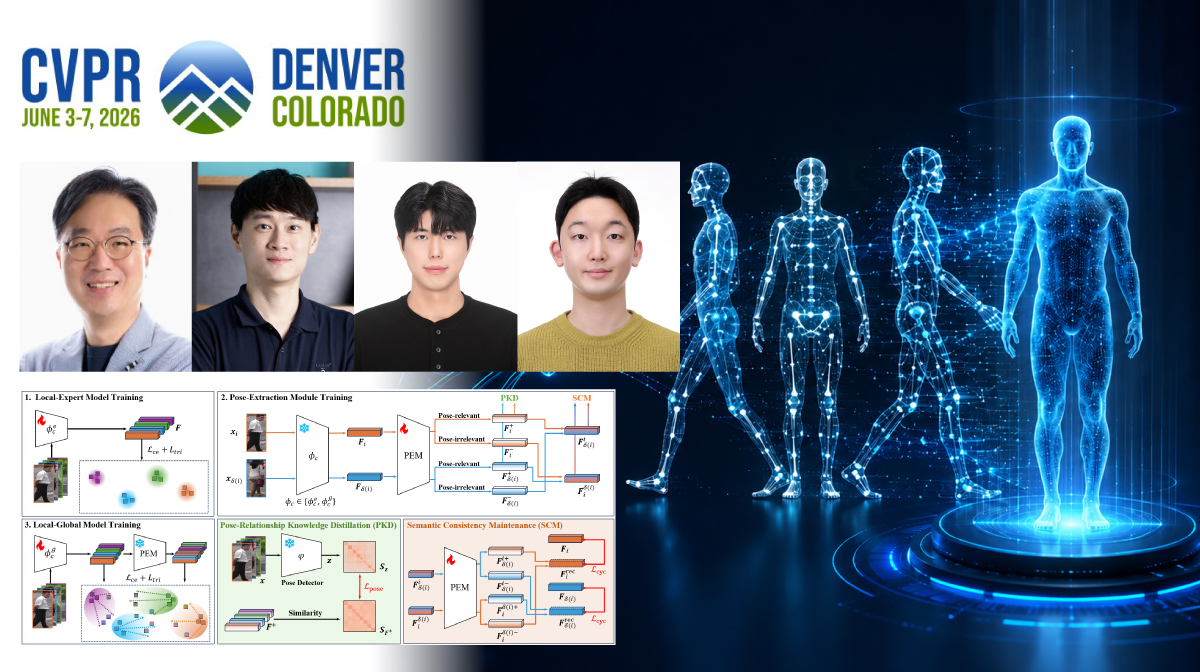
Better AI often begins with better data. For systems designed to identify the same person across different camera views—whether for missing-person searches or public safety—that data is becoming harder to obtain as privacy concerns restrict the sharing of sensitive video. A research team, led by Professor Jae-Young Sim of the Graduate School of Artificial Intelligence at UNIST has developed a federated learning method that overcomes this challenge without transferring raw camera footage to a central server.
Determining whether people captured by different cameras are the same individual—a task known as Person Re-Identification (ReID)—is essential for a wide range of AI vision systems. While federated learning enables models to be trained without sharing sensitive images, distributing training across individual cameras creates an unexpected challenge: each camera observes people from only a limited range of viewpoints.
A camera mounted at one location may capture mostly front-facing views, while another records only side or rear profiles. As a result, local AI models learn from incomplete pose information, making it more difficult for the combined federated model to accurately recognize the same person under different viewing conditions.
To overcome this limitation, the research team developed Pose-guided Enriched Feature Learning (PEFL). Rather than generating or exchanging additional images, PEFL separates visual features related to a person's identity from those associated with pose, then recombines them to synthesize feature representations from viewpoints that were never observed by an individual camera. The approach expands pose diversity during training while preserving each person's distinctive characteristics.
The researchers evaluated PEFL using the widely adopted Market-1501 and MSMT17 benchmarks under a federated-by-camera setting. The method achieved a mean Average Precision (mAP) of 45.9%, improving on the previous state of the art by 4.5 percentage points, while reaching a Rank-1 accuracy of 66.4%.
“We found that the limited range of viewpoints captured by individual cameras significantly reduces the effectiveness of federated person re-identification,” said JooHyung Oh, co-first author of the study. “By enriching pose diversity without sharing raw images, our method enables models to learn more robust identity representations.”
Professor Sim added, "Privacy and performance are often viewed as competing goals in AI. Our work shows they do not have to be. We hope this approach will contribute to distributed vision systems that require both strong recognition performance and robust privacy protection."
The study was co-first authored by JooHyung Oh and Minyoung Oh of UNIST. The research was accepted for presentation at the IEEE/CVF Conference on Computer Vision and Pattern Recognition (CVPR) 2026 , one of the world's leading conferences in computer vision.
Journal Reference
JooHyung Oh, Minyoung Oh, Sung Whan Yoon, and Jae-Young Sim, "Pose-guided Enriched Feature Learning for Federated-by-camera Person Re-identification," CVPR '26, (2026).
Related Links