UNIST site map
- Admissions
-
Academics
- Colleges and Schools
-
Academic Affairs
- Academic Calendar
- Academic Curriculum
- Requirements for Graduation
- Browse Open Courses
- Undergraduate Administration
-
Graduate Academic Affairs
- Tuition Fee Payment
- Academic Leave of Absence/ Academic Return
- Voluntary Withdrawal/ Expulsion
- Change of Major
- Change of Degree Program/ Dropping of Degree Program
- Class Period/ Attendance Period/ Academic Year・Semester
- Course Registration
- Course Drop
- Attendance/ Grade/ Exam
- Credit Transfer/ Credit Carryover
- Academic Forms
- Education Support
-
Research/Industry
- Research Aims
- Research Findings
- Researcher Search
-
Research Organizations
- UNIST Multi-Interdisciplinary Institute
- IBS Research Groups
-
UNIST Labs
- Department of Mechanical Engineering
- School of Energy and Chemical Engineering
- Department of Civil
- Department of Materials Science and Engineering
- Department of Nuclear Engineering
- Department of Industrial Engineering
- Department of Design
- Department of Biomedical Engineering
- Department of Biological Sciences
- Department of Electrical Engineering
- Department of Computer Science and Engineering
- Department of Mathematical Sciences
- Department of Chemistry
- Department of Physics
- School of Business Administration
- Graduate School of Carbon Neutrality
- Graduate School of Artificial Intelligence
- Research Support
- University-Industry Relations
- Campus Life
- News Center
- About UNIST
-
etc
- UNIST Bulletin
- Work-Life Balance Support System
- UNIST Gender Equality Plan
- Faculty Invitation for Tenure Track
- Faculty Invitation for Non-Tenure Track
- Board Meeting Minutes
- University Council Meeting Minutes
- Administrative Service Charter
- Privacy Policy
- Copyright Policy
- Rejection of Unauthorized Email Collection
- Information Disclosure
SEARCH


Connection Points of Knowledge, Everything About UNIST
Try searching.
Recommended search terms


STUDENT


- portal
- U Academics Innovation Center
- Leadership Center
- Dormitory
- Academic Information Center
- International Students Support
- Browse Open Courses
- Course Registration
- Graduation Requirements for Graduation
- Academic Leave of Absence/ Academic Return
- Military Service
- Certificate Issuance
- Academic Calendar
- Scholarships
- Campus Map
- Campus Life Guidebook
- Health Care Center
- Human Rights Center
- portal
- Job Opening
- Announcement for Bid
- UNIST AI Services
- UNIST Daycare Center
- Sports Center
- UI Downloads
- Announcement
- Recruitment of Professors (Non-tenure)
- Faculty Invitation for Tenure Track
- UNIST Academic Information Center
- Office of Research Facilities and Training
- Office of Research Affairs
- Rule Management System
- Academic Calendar


This is a collection of menus necessary for UNIST students .
students
- portal
- U Academics Innovation Center
- Leadership Center
- Dormitory
- Academic Information Center
- International Students Support
- Browse Open Courses
- Course Registration
- Graduation Requirements for Graduation
- Academic Leave of Absence/ Academic Return
- Military Service
- Certificate Issuance
- Academic Calendar
- Scholarships
- Campus Map
- Campus Life Guidebook
- Health Care Center
- Human Rights Center


This is a collection of menus necessary for prospective UNIST Students .
prospective Students


This is a collection of menus necessary for UNIST Faculty & Staff .
Faculty & Staff
- portal
- Job Opening
- Announcement for Bid
- UNIST AI Services
- UNIST Daycare Center
- Sports Center
- UI Downloads
- Announcement
- Recruitment of Professors (Non-tenure)
- Faculty Invitation for Tenure Track
- UNIST Academic Information Center
- Office of Research Facilities and Training
- Office of Research Affairs
- Rule Management System
- Academic Calendar


NEWS CENTER
Discover not only Research Findings and event news, but also the diverse facets of UNIST presented by reporters and writers.
News Center

UNIST News
총 3341건의 게시물이 있습니다.
There are a total of 3341 posts.
-
Research
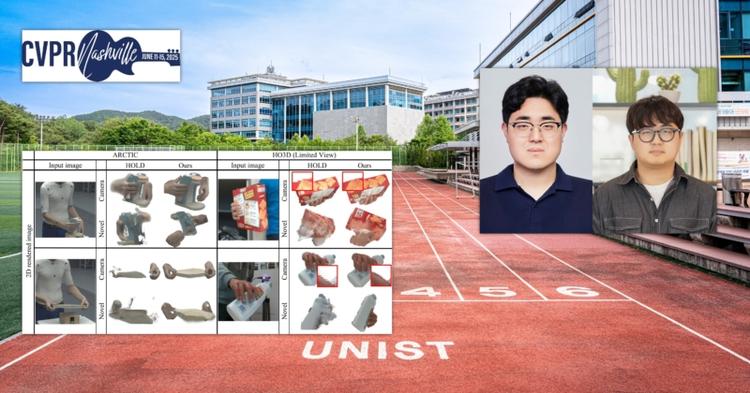
"More Realistic Surgical Simulations" — AI Innovation for Reconstructing 3D Hand-Object InteractionsThe findings have been accepted for presentation at the CVPR 2025, which will be held in the United States from June 11 to 15, 2025.
Abstract Reconstructing 3Ds of hand-object interaction (HOI) is a fundamental problem that can find numerous applications. Despite recent advances, there is no comprehensive pipeline yet for bimanual class-agnostic interaction reconstruction from a monocular RGB video, where two hands and an unknown object are interacting with each other. Previous works tackled the limited hand-object interaction case, where object templates are pre-known or only one hand is involved in the interaction. The bimanual interaction reconstruction exhibits severe occlusions introduced by complex interactions between two hands and an object. To solve this, we first introduce BIGS (Bimanual Interaction 3D Gaussian Splatting), a method that reconstructs 3D Gaussians of hands and an unknown object from a monocular video. To robustly obtain object Gaussians avoiding severe occlusions, we leverage prior knowledge of pre-trained diffusion model with score distillation sampling (SDS) loss, to reconstruct unseen object parts. For hand Gaussians, we exploit the 3D priors of hand model (i.e., MANO) and share a single Gaussian for two hands to effectively accumulate hand 3D information, given limited views. To further consider the 3D alignment between hands and objects, we include the interacting-subjects optimization step during Gaussian optimization. Our method achieves the state-of-the-art accuracy on two challenging datasets, in terms of 3D hand pose estimation (MPJPE), 3D object reconstruction (CDh, CDo, F10), and rendering quality (PSNR, SSIM, LPIPS), respectively. Researchers at UNIST have announced the development of a groundbreaking artificial intelligence (AI) technology capable of reconstructing three-dimensional (3D) representations of unfamiliar objects manipulated with both hands, as well as simulated surgical scenes involving intertwined hands and medical instruments. This advancement enables highly accurate augmented reality (AR) visualizations, further enhancing real-time interaction capabilities. Led by Professor Seungryul Baek of the UNIST Graduate School of Artificial Intelligence, the team introduced the BIGS (Bimanual Interaction 3D Gaussian Splatting), an innovative AI model that can visualize complex interactions between hands and objects in 3D using only a single RGB video input. This technology allows for the real-time reconstruction of intricate hand-object dynamics, even when the objects are unfamiliar or partially obscured. Traditional approaches in this domain have been limited to recognizing only one hand at a time or responding solely to pre-scanned objects, restricting their applicability in realistic AR and VR environments. By contrast, BIGS can reliably predict full object and hand shapes, even in scenarios where parts are hidden or occluded, and can do so without the need for depth sensors or multiple cameras—relying solely on a single RGB camera. The core of this AI model is based on 3D Gaussian Splatting, a technique that represents object shapes as a cloud of points with smooth Gaussian distributions. Unlike point cloud methods that produce sharp boundaries, Gaussian Splatting enables natural reconstruction of contact surfaces and complex interactions. The model further addresses occlusion challenges by aligning multiple hand instances to a canonical Gaussian structure and employs a pre-trained diffusion model for score distillation sampling (SDS), allowing it to accurately reconstruct unseen surfaces, including the backs of objects. Figure 1. Results of reconstructing hand-object interactions from various viewpoints using the ‘BIGS’ method. Extensive experiments utilizing international datasets such as ARCTIC and HO3Dv3 demonstrated that BIGS outperforms existing technologies in accurately capturing hand postures, object shapes, contact interactions, and rendering quality. These capabilities hold significant promise for applications in virtual and augmented reality, robotic control, and remote surgical simulations. This research was conducted with contributions from first author Jeongwan On, along with Kyeonghwan Gwak, Gunyoung Kang, Junuk Cha, Soohyun Hwang, and Hyein Hwang. Professor Baek remarked, "This advancement is expected to facilitate real-time interaction reconstruction in various fields, including VR, AR, robotic control, and remote surgical training." The findings have been accepted for presentation at the CVPR 2025 (Conference on Computer Vision and Pattern Recognition), a premier international conference in the field of computer vision, which will be held in the United States from June 11 to 15, 2025. This research was supported by the Ministry of Science and ICT, the National Research Foundation of Korea, and the Institute for Information & Communications Technology Planning & Evaluation (IITP). Journal Reference Jeongwan On, Kyeonghwan Gwak, Gunyoung Kang, et al., "BIGS: Bimanual Category-agnostic Interaction Reconstruction from Monocular Videos via 3D Gaussian Splatting," CVPR 2025, (2025).- 2025-06-12
- JooHyeon Heo
- 718
-
Research
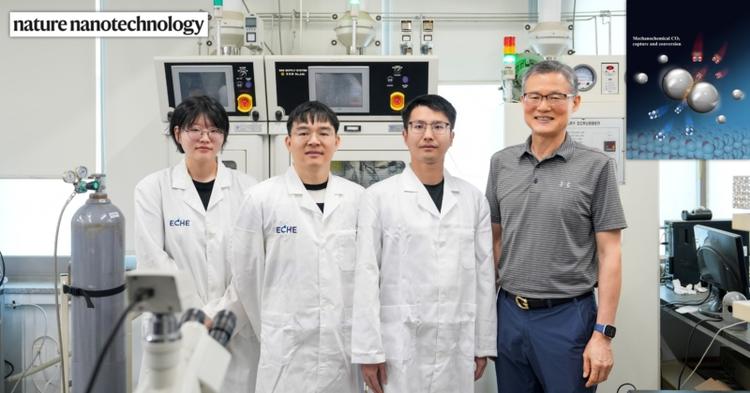
Mechanochemical Approach for Low-Temperature CO2 Capture and ConversionTheir findings have been published in Nature Nanotechnology on June 5, 2025.
Abstract Developing a direct carbon dioxide (CO2) capture and methanation method is one of the most important challenges to achieving carbon neutrality. However, converting CO2 into methane (CH4) kinetically requires the activation of stable CO2 at high temperatures (300–500 °C), while the CO2-to-CH4 conversion thermodynamically favours low temperatures. Here we report an efficient mechanochemical CO2 capture and conversion under mild conditions (65 °C). Using commercial zirconium oxide (ZrO2) and nickel catalysts, the mechanochemical CO2 capture capacity was 75-fold higher than the conventional thermochemical process. The mechanochemical CO2 conversion reached a nearly quantitative CO2 conversion (99.2%) with CH4 selectivity (98.8%). We determined that repeatedly induced abundant oxygen vacancies on ZrO2 by dynamic mechanical actions are responsible for efficient CO2 capture and, thus, subsequently spontaneous methanation. A pioneering approach has been developed to convert carbon dioxide (CO₂) into methane (CH₄)—the main component of natural gas—at room temperature. Traditionally, this process requires high temperatures above 300°C, making it energy-intensive and costly. The new method, which involves just rotating raw materials with steel balls, was recently published in Nature Nanotechnology, a top journal in nanoscience. Led by Professor Jong-Beom Baek in the School of Energy and Chemical Engineering and Professor Hankwon Lim of the Graduate School of Carbon Neutrality at UNIST, the research team announced that they have successfully created a mechanochemical process, capable of converting CO₂ into CH₄ efficiently at just 65°C. This simpler, low-energy approach could accelerate the shift toward a sustainable, carbon-neutral future. The process uses a ball mill—a device containing small steel balls of a few millimeters in diameter—filled with catalysts and raw materials. As the mill rotates, collisions and friction activate the catalyst surfaces, enabling CO₂ to be captured and react with hydrogen to produce methane. Remarkably, the team achieved a 99.2% conversion rate of CO₂ at this low temperature, with 98.8% of the reacted CO₂ turning directly into methane, rather than byproducts. The process also proved highly effective in continuous operation, maintaining an 81.4% reaction participation rate and 98.8% methane selectivity even at 15°C, below room temperature. This demonstrates its potential for scalable industrial use. Figure 1. Schematic image, illustrating the mechanochemical CO2 capture and conversion. The process leverages commercially available zirconium oxide (ZrO₂) and nickel catalysts, which are both affordable and widely used in industry. Nickel helps split hydrogen molecules, while zirconium oxide enhances CO₂ activation. The mechanical impacts within the ball mill induce oxygen vacancies in zirconium oxide, trapping CO₂ molecules and enabling their reaction with hydrogen on the nickel catalyst to produce methane. Economic assessments suggest that because the process operates at low temperatures and utilizes readily available catalysts without extensive pre-treatment, it can significantly reduce equipment and operational costs. Professor Lim explained, "When powered by renewable energy sources, like wind or solar, this method could cut energy consumption in half compared to conventional thermochemical processes." Professor Baek highlighted the practical significance by saying "This technology makes it possible to convert CO₂ directly into fuel on-site, without the need for high-temperature, high-pressure equipment. It not only reduces carbon emissions but also lowers infrastructure and transportation costs, offering a promising pathway toward carbon neutrality." This research was conducted in collaboration with Professor Qunxiang Li of the University of Science and Technology of China (USTC), with support from the National Research Foundation (NRF) of Korea and the UNIST Carbon Neutrality Demonstration and Research Center. Journal Reference Runnan Guan, Li Sheng, Changqing Li, et al., "Mechanochemical carbon dioxide capture and conversion," Nat. Nanotechnol., (2025).- 2025-06-11
- JooHyeon Heo
- 1542
-
News
UNIST and HD Hyundai Heavy Industries Collaborate on Eco-Friendly Ship Engine TechnologyUNIST's High-assurance Mobility Control Laboratory Selected as an Industry-Academia Collaboration-Focused Research Institute to Commercialize Advanced Engine Solutions
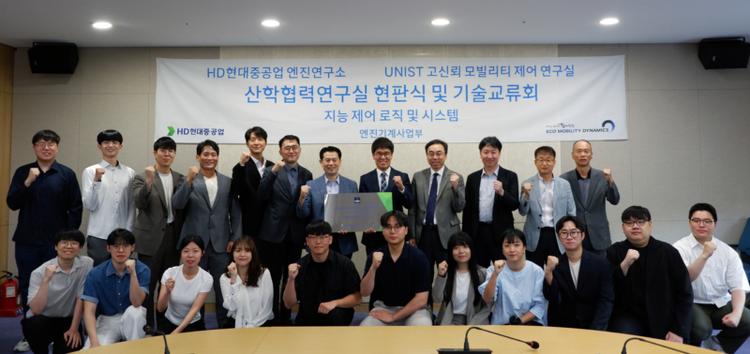
On June 10, UNIST and HD Hyundai Heavy Industries (HHI) Co., Ltd. have entered into a strategic partnership aimed at advancing and commercializing environmentally friendly ship engine technologies. The collaboration was officially launched during a ceremony held at UNIST, which included the unveiling of an industry-academic cooperation plaque and a technology exchange session. This partnership was initiated as a result of the High-assurance Mobility Control Laboratory (HMCL), affiliated with the Department of Mechanical Engineering at UNIST, being designated as an industry-academia collaboration-focused research institute under the Engine Research Institute of HHI. The project focuses on the development of intelligent control logic and systems for ship engines. UNIST is the third institution, following Hanyang University and the University of Ulsan, to receive this recognition. The plaque unveiling ceremony was attended by Vice President Sung Chul Bae of Academic Affairs, Department Head Jaeseon Lee of the Department of Mechanical Engineering, Professor Cheolhyeon Kwon at UNIST, Director Sung-Chan An of HHI Engine Research Institute, and Sung Hoon Ko, Head of the Intelligent Control Systems Laboratory. Following the ceremony, a technical exchange session was held where UNIST shared its research achievements on "Efficient Control Software Verification Technologies." HD Hyundai Heavy Industries presented their latest advancements in eco-friendly engine control technologies, including element control strategies and hybrid propulsion control systems. The HMCL Laboratory has been dedicated to researching intelligent control system reliability and stability across various mobility sectors, including ships and vehicles. Recent collaborative efforts with HD Hyundai Heavy Industries have yielded significant progress in software verification and development for ship engines. Building on this foundation, the two organizations will intensify their joint research efforts to develop advanced intelligent control logic and systems, with the ultimate goal of securing leading global technologies and cultivating top-tier research talents. Professor Kwon expressed enthusiasm about the partnership, stating, "The designation as a focused industry-academic research center will enhance UNIST’s mechanical engineering research capabilities. HMCL aims to contribute to the development of reliable and stable intelligent control systems." Director Sung-Chan An of HHI Engine Research Institute emphasized, "Through continued collaboration with UNIST, we will further develop cutting-edge control technologies and strengthen our technological leadership in the global engine market."- 2025-06-11
- JooHyeon Heo
- 753
-
기고
[배성철칼럼]AI 시대 대학 교육 혁신에 대한 도전(1)기초과학분야까지 파괴적 혁신 대상
전문지식 전달 기존 교육 한계 직면… AI시대, 대학도 변화·혁신 서둘러야지난 주말 미국에서 같이 지냈던 다섯 가족이 수원에서 만나 지난 시간들을 돌아보며 회포를 풀 시간을 가졌다. 다양한 화제를 가지고 이야기를 하다보니 자연스럽게 교육에 대한 이야기로 집중됐다. 다섯명 중 네명이 현역 이공계 교수다. 미국 일리노이 대학교, 서울대학교, 성균관대학교에서 나름 이공계에서 새로운 교육의 변화를 고민하고 새로운 시도를 하고 계신 분들이다. 학술적인 모임은 아니었지만 오히려 감출 것 없이 허심탄회한 각자의 고민과 생각들을 들을 수 있는 좋은 기회였다. 많은 이야기가 오고 갔지만 모두가 공감하는 한가지는 지금 MZ세대들의 성향과 인공지능(AI)의 급속한 발전을 고려할 때 기존 대학 강의실에서 이뤄지는 지식전달 방식이 더 이상 유효하지 않다는 것이다. 어떻게 대응할 것인가에 대해서는 여전히 다양한 의견들이 존재하지만 대학교육의 변화와 혁신의 시급성에 대해서는 누구도 부인할 수 없었다. 오늘부터는 그동안 논의하던 바이오산업에 대한 주제를 잠시 접어두고 대학교육에 대한 이야기를 나눠보고자 한다. 미국 대학들은 요즘 정체성의 위기에 직면해 있다. 트럼프 정부의 급작스러운 정책변화도 있지만, 대학이 지식의 상아탑이라는 자부심과 미래 전문가와 리더를 양육하는 교육기관이라는 입지가 위협과 도전에 직면해 있다. 지금까지 대학은 미래 리더를 교육하고 과학기술의 혁신을 이끌어가며 젊은 인재들이 모여 새로운 도전을 할 수 있는 최고의 기관으로 여겨져 왔다. 하지만 최근의 디지털 혁신이나 AI 기술 혁신은 대학이 주도적인 역할을 하고 있는가? 이 혁신을 주도하는 젊은 인재들이 대학으로 모이고 있는가? 냉정하게 이야기하자면 그렇지 않다. AI 분야의 최고 인재들은 글로벌 기업에 모여있다. 이들은 오랜 시간 체계적인 교육을 통해 양육된 박사학위를 가진 사람들이 아니다. 이들에게 대학의 학위나 졸업장은 무의미하고, 대학은 더 이상 매력적인 기관이 아니다. 이런 현상을 AI 기술로 한정된 것이라 생각하고 싶지만, 지난 노벨 물리상과 화학상을 지켜보면서 이 변화가 특정분야에만 한정된 것이 아니라는 생각이 든다. 기초과학 분야도 이제는 AI 기술에 의한 파괴적 혁신의 대상이 됐다. 이것을 단순히 미국 대학의 위기로만 볼 것인가? 그렇지 않다. 요즘 강의실에서 교수와 학생들의 모습을 생각해 보면 이런 위기감은 더욱 심각해진다. 많은 학생을 앞에 두고 전문지식을 일방적으로 전달하던 강의 방식은 회의감이 든다. 어떤 교수는 가능한 많은 정보를 전달하기 위해 칠판에 판서를 하지 않고 수십장의 파워포인트 슬라이드를 준비한다. 얼마나 많은 슬라이드를 준비했는지에 자부심을 느끼기도 한다. 하지만 정보의 디지털화와 AI의 보급으로 이제 학생들은 강의실에서 전문 지식을 기대하지 않는다. 그 수업의 기존 강의 노트, 슬라이드와 시험, 과제에 대한 정보는 이미 확보돼 있으며, 새로운 과제를 제시하더라도 AI를 활용하면 굳이 수업을 듣지 않아도 해결이 가능하다. 수업시간에 학생들은 교수의 강의를 필기하지 않는다. 강의내용을 사진으로 촬영하거나 녹화를 하고 AI로 요약한다. 최근 어느 교수의 고민을 듣게 됐다. 이번 학기 학생들이 제출한 과제 성과물이 예전과 비교해 훨씬 좋아졌지만, 중간고사 성적은 오히려 많이 떨어져서 당황스럽다는 것이다. 과제는 AI를 활용해 성과가 좋아졌지만, 지식을 소화하고 이해하는 능력은 떨어져서 시험 성적은 떨어진 것으로 보인다. 학생들을 탓하고자 하는 것이 아니다. 이미 AI라는 혁신적인 도구는 학생들에게 주어져있다. 미래를 살아가야 할 학생들에게는 이 도구를 잘 사용하는 것이 무엇보다 중요하다. 기존의 교육방식을 고집하며 이런 변화를 부정하고 예전에 가르치던 방식을 학생들에게 강요하는 대학이 혁신돼야 한다. 미래 리더로 갖춰야 할 역량이 무엇인지는 재구성돼야 하며, 전문 지식인의 정의가 다시 평가돼야 한다. 그리고 교육은 이러한 역량을 증진시킬 새로운 방법과 내용들로 채워져야 할 것이다. 앞으로 몇 차례에 걸쳐 이러한 쟁점들에 대한 논의들을 해보려고 한다. <본 칼럼은 2025년 6월 11일 경상일보 “[배성철칼럼]AI 시대 대학 교육 혁신에 대한 도전(1)"라는 제목으로 실린 것입니다.>- 2025-06-11
- 배 성철
- 497
-
News
Successful Completion of the 2025 UNIST Spring Festival, "UNIVERSE"Record-breaking Attendance and Diverse Programs Foster Unity at UNIST
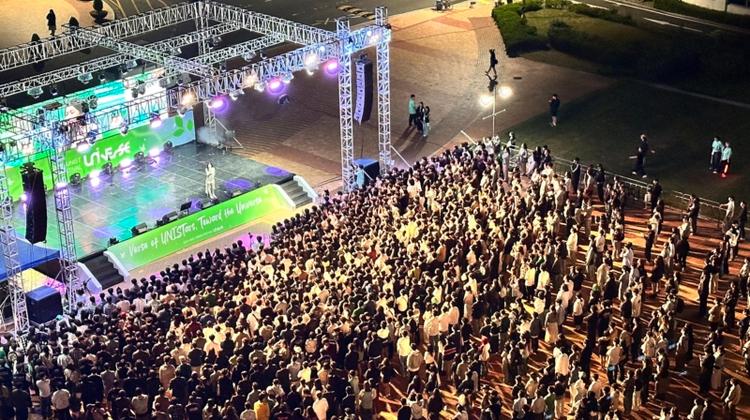
The 2025 UNIST Spring Festival, titled "UNIVERSE," concluded successfully after a two-day celebration held from May 30 to May 31, 2025. The event drew enthusiastic participation from students, faculty, staff, and the local community, creating a vibrant and memorable atmosphere across campus. The theme of this year's festival, "Capturing Our Moment as We Step into the World," was selected through a student-led contest, reflecting the university's commitment to student engagement and creativity. During the festival, the campus was alive with the energy of early summer, with activities and performances transforming various campus venues—including the plaza in front of the Main Administration and the Business Administration Buildings, as well as the lawn in front of the Engineering Buildings—into lively celebration spaces. The event drew large crowds, including faculty and staff families, contributing to an atmosphere of shared joy and community. A highlight was the "ME:LODY Contest," held on the lawn in front of the Engineering Buildings as evening approached. As the sunset cast a warm glow and delicate lighting transformed the scene into a work of art, student performers captivated audiences with singing, dancing, and band performances, creating a romantic and inspiring stage. Vice President Sung Chul Bae of Academic Affairs, who visited the festival amidst his busy schedule, encouraged students to relax and enjoy the event as an opportunity to relieve academic stress and create lasting memories, receiving enthusiastic cheers from attendees. At the student booth zone on the Business Administration Building lawn, a variety of experiential and culture programs were offered. Notably, for the first time, local government booths from Ulsan Youth Center and Ulju Mental Health Welfare Center participated, strengthening collaboration with the local community. Additionally, the UNIST Human Rights Center hosted the "Create Your Own Respect Aquarium" booth, engaging many students and fostering reflection on shared values. On the night of May 31, the university plaza stage became a shining "Verse" of celebration. The evening commenced with performances by the winning team from a university-wide competition, followed by dynamic performances from UNIST student clubs. Students showcased their talents developed throughout the semester, fully enjoying their time on stage. This year's festival attracted unprecedented attendance, with large audiences filling the front of the stage, and the performance of guest singers, Heize and Raewon, reaching a peak of excitement. Attendees sang along, cheered loudly, and brought the festival’s final night to a spectacular close. YeLim Kim, Chair of the Festival Planning Committee, expressed pride in the high level of student participation, stating, "More students than ever before took part, making this event especially meaningful." UNIST Student Council President SeongGeun Ahn also thanked the university leadership and staff for supporting the event, saying, "We are grateful for the opportunity to come together and celebrate after a long hiatus since the pandemic." President Chong Rae Park praised the event, noting, "The diverse talents and spirit of challenge demonstrated by our students were truly inspiring." He added, "I hope this experience will serve as a foundation for students to grow into future leaders capable of shaping society." Looking ahead, the student team plans to expand programs that foster engagement among both campus and external communities, continuing to cultivate a lively and warm university environment.- 2025-06-11
- JooHyeon Heo
- 318
-
Community
Professor Cheolhyeon Kwon's Team Wins 2nd Place at the 24th Roboracer Autonomous Grand Prix CompetitionProfessor Cheolhyeon Kwon's team secured 2nd place at the '24th Roboracer Autonomous Grand Prix Competition,' held in Atlanta, Georgia, on March 22, 2025.
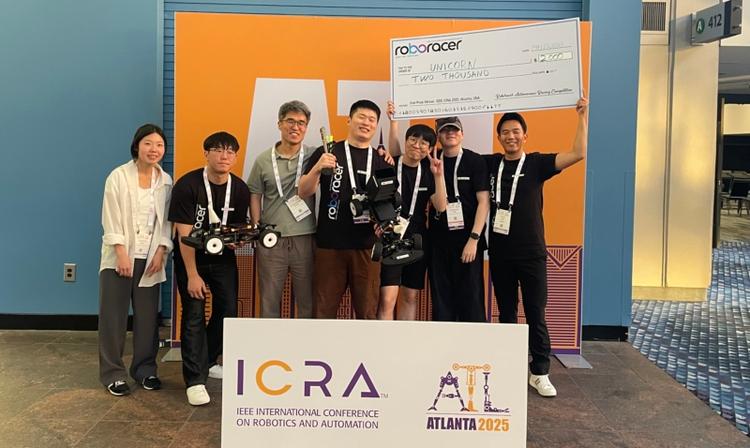
A research team, led by Professor Cheolhyeon Kwon in the Department of Mechanical Engineering at UNIST announced their outstanding achievement at the '24th Roboracer Autonomous Grand Prix Competition,' held in Atlanta, Georgia, on March 22, 2025. The team secured the second place among 18 international university teams competing in this prestigious event. This year's competition was an official side event of the 2025 IEEE International Conference on Robotics and Automation (ICRA), the world's foremost conference dedicated to advancing the field of robotics. Participants included leading universities, such as the University of Pennsylvania, ETH Zurich, and the University of Bologna, among others. Team UNICORN is preparing for an autonomous racing event. This racing vehicle features a 3D-printed horn with LEDs installed, allowing real-time monitoring of the vehicle's status. Team UNICORN showcased a rapid and stable autonomous driving system that incorporates vehicle-to-vehicle interaction considerations. Notably, they developed a 3D-printed horn equipped with LED indicators to provide real-time status updates of the vehicle. During operation, the system displays different colors. For instance, blue indicates unrecognized obstacles, yellow signifies following another vehicle, and red signals an overtaking attempt. Leveraging advanced perception technology capable of reflecting variables such as frictional changes in the racing environment, Team UNICORN demonstrated exceptional driving performance. Furthermore, they utilized data from competing vehicles to successfully execute overtaking maneuvers, showcasing autonomous capabilities that go beyond basic collision avoidance and highlighting their ability to handle complex racing scenarios. Professor Kwon stated, "This achievement affirms the global competitiveness of UNIST’s autonomous driving technology." He further noted, "Moving forward, we aim to enhance our systems by integrating vehicle interaction and environmental factors, thereby strengthening our position in the international arena." The team's success underscores UNIST's commitment to pioneering innovative autonomous vehicle technologies and fostering research that pushes the boundaries of robotics and intelligent systems.- 2025-06-10
- JooHyeon Heo
- 1013
-
기고
[안현실칼럼]노바투스의 꿈, ‘산업현장을 AI 학교로’인구감소 시대 한국 성장해법은 AI, 울산 ‘글로벌 산업AI 허브’ 가능성
기술자→AI인재 전환 생산성 향상외국인 노동자를 구할 수 없다면 지역이든 국가든 계속 성장할 수 있을까? 미국 워싱턴 대학은 세계인구가 2064년 97억명을 정점으로 줄어들 것으로 예측했다. 인류 30만년 역사에서 역병이나 재해 등으로 인한 일시적인 인구감소를 제외하면 처음이다. 인구증가 시대의 성장공식과 인구감소 시대의 성장공식이 같을 수 없다. 저소득 인구증가 국가에서 고소득 인구감소 국가로 생산가능인구가 이동하는 글로벌 흐름에 제동이 걸리는 것은 시간의 문제다. 앞으로 벌어지는 전쟁은 인구 빼앗기로 흐를지 모른다. 실제로 러시아-우크라이나 전쟁조차 러시아의 인구감소가 한 요인으로 꼽히기도 한다. 외국인 노동자를 구하려는 국가는 지금보다 훨씬 좋은 조건을 제시하며 출혈 경쟁을 불사해야 한다. 반대로 외국인 노동자는 ‘갑’이 돼 자신을 필요로 하는 국가를 놓고 쇼핑할 것이다. 그 사이 저소득 국가가 본격적인 성장 궤도를 올라타면 고소득 국가로의 노동 이동은 결국 종말을 맞이할 공산이 크다. 한국은 이미 인구감소 국가다. 외국인 노동자를 구할 수 없는 날이 다가오고 있다면, 기존의 성장공식으로부터 탈피해야 한다. 성장률에서 인구변화율을 빼면 삶의 질(質)이라는 공식이 이를 말해준다. 성장률을 유지할 수 있다면 인구가 감소할 때 삶의 질은 순간적으로 향상된다. 문제는 성장률이 인구감소율보다 더 빨리 추락하는 경우다. 이때는 삶의 질 악화가 불가피하다. 탈출할 수 있는 방법은 딱 하나밖에 없다. 인구가 줄어드는 속도보다 1인당 생산성을 더 빠른 속도로 끌어올리는 것이다. 인공지능(AI) 기술의 등장은 시대적 관점에서 보면 ‘우연’이 아니라 ‘필연’이다. AI발(發) ‘신(新)생산성 혁명’의 성패 여부가 지역이든 국가든 그 운명을 갈라놓을 것이다. 한국은, 그리고 산업도시 울산은 이에 대비하고 있는가? AI 기술혁신과 기술확산 사이에는 갭(gap)이 있다. 처음에는 생산성이 하락하다가 일정 시간이 지나서야 생산성이 올라가는, 소위 ‘J-커브’ 현상은 그런 갭의 결과다. 사람이 얼마나 빨리 새로운 변화에 적응하고 인공지능(AI)을 활용할 수 있느냐가 관건이다. 크게 보면 AI 인재는 개발과 활용으로 나뉜다. AI 기술을 좌우하는 세계 인재 2000명 가운데 한국인은 한 자릿수에 불과하다는 분석이 있다. 그렇다고 좌절할 이유는 없다. AI 고급인재 양성은 UNIST 등 정부가 지정한 인공지능대학원이 분발하면 된다. 더 시급한 과제는 당장 산업현장에서 생산성과 씨름하는 기술자, 엔지니어를 어떻게 산업AI 인재로 전환하느냐다. 울산에는 울산시와 UNIST가 손잡고 이미 시작한 ‘노바투스 아카데미아’가 있다. UNIST 인공지능대학원 교수가 기업이 직면한 프로젝트를 놓고 산업현장 인력과 함께 AI로 문제를 해결하는 16주 단기과정이다. 이른바 프로젝트 기반 학습(PBL)이다. ‘혁신’과 ‘변혁’을 의미하는 노바투스라는 이름답게 지난 몇 년간 쌓인 성과는 독보적이라고 할 정도다. 수요 예측, 유지·보수, 공정 최적화, 품질관리 등 수많은 성공 사례는 그 자체로 산업AI의 베스트 프랙티스다. 실제 성과가 눈앞에 나타나자 중소기업 CEO가 AI를 보는 눈빛이 달라지기 시작했다. CEO를 대상으로 한 노바투스 AI 최고위과정이 최근 출범한 계기다. 노바투스가 입소문을 타자 이번에는 산업AI 석사과정을 희망하는 목소리가 들려오기 시작했다. 이에 부응해 노바투스 대학원이 올해 가을학기부터 문을 연다. 울산 산업제조 중소기업의 AI 전환을 위한 UNIST 노바투스의 꿈이 완성되고 있다. 울산의 노바투스는 부산, 경남으로 확장 중이다. 중소벤처기업부는 노바투스 프로그램을 직접 확인하고 싶다며 울산중기청과 함께 UNIST를 찾아왔다. 정부가 구상해온 중기현장 AI인재 양성모델이 몇 년 전부터 울산에서 실행되고 있다는 사실에 놀라워했다. 산업AI의 최고 솔루션은 AI를 활용해 생산성을 높이는 현장의 인재다. 기술자, 엔지니어가 모두 AI 인재로 바뀌는 날, 울산은 산업AI에 관한 한 세계 최대 인재도시이자 최고 R&D도시로 변해 있을 것이다. 글로벌 산업AI 허브가 울산의 미래다. <본 칼럼은 2025년 6월 10일 경상일보 “[안현실칼럼]노바투스의 꿈, ‘산업현장을 AI 학교로’"라는 제목으로 실린 것입니다.>- 2025-06-10
- 안 현실
- 334
-
Research
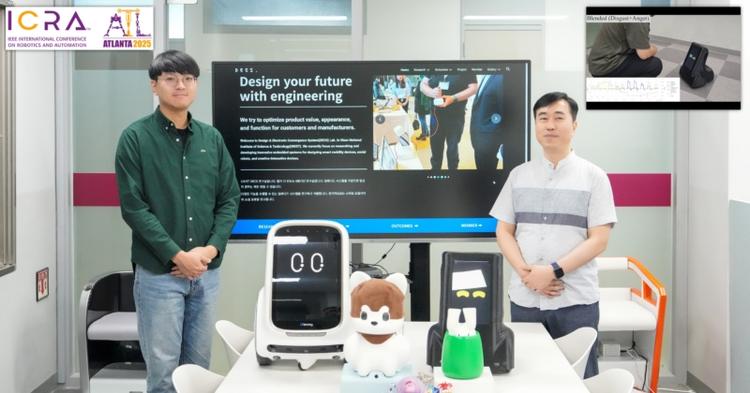
Breakthrough in Robotics: Dynamic Emotion Modeling for More Responsive Social RobotsThe research was accepted for presentation at the 2025 IEEE International Conference on Robotics and Automation (ICRA), held 19-23 May 2025 in Atlanta, Georgia, USA.
Abstract Social robots have been extensively studied in recent decades, with many researchers exploring the use of modalities such as facial expressions to achieve more natural emotions in robots. Various methods have been attempted to generate and express robot emotions, including computational models that define an affect space and show dynamic emotion changes. However, the implementation of multimodal expression in previous models is ambiguous, and the generation of emotions in response to stimuli relies on heuristic methods. In this paper, we present a framework that enables robots to naturally express their emotions in a multimodal way, where the emotion can change over time based on the given stimulus values. By representing the robot’s emotion as a position in an affect space of a computational emotion model, we consider the given stimuli values as driving forces that can shift the emotion position dynamically. In order to examine the feasibility of our proposed method, a mobile robot prototype was implemented that can recognize touch and express different emotions with facial expressions and movements. The experiment demonstrated that the emotion elicited by a given stimulus is contingent upon the robot’s previous state, thereby imparting the impression that the robot possesses a distinctive emotion model. Furthermore, the Godspeed survey results indicated that our model was rated significantly higher than the baseline, which did not include a computational emotion model, in terms of anthropomorphism, animacy, and perceived intelligence. Notably, the unpredictabil ity of emotion switching contributed to a perception of greater lifelikeness, which in turn enhanced the overall interaction experience. Imagine a scenario in which an individual experiences a sudden tap on their shoulder. In response, their eyes may widen, or they may instinctively flinch. Such stimuli naturally provoke automatic reactions in humans, though these responses tend to diminish or evolve with repeated exposure over time. Building on this understanding of human emotional dynamics, researchers have developed an innovative robotic system capable of simulating adaptive emotional responses based on stimulus frequency and context. This advancement aims to enhance emotional engagement in social and companion robots. Professor Hui Sung Lee and his team from the Department of Design at UNIST announced the development of this adaptive robot technology, which expresses emotions through changes in eye shape, color, and movement, with responses that evolve dynamically over time. Shown above is a recently developed companion robot expresses happiness when gently touched. l Image Credit: Professor Hui Sung Lee (Department of Design, UNIST) The robot is capable of displaying six distinct emotions by combining variations in eye appearance, color, and movement patterns. Interactions are initiated via physical touch—either stroking (representing positive stimuli) or tapping (representing negative stimuli) on the robot's head. For instance, a sudden tap causes the robot’s eyes to enlarge, turn blue, and its body to lean backward, thereby conveying surprise. Crucially, when the same stimulus is repeated, the robot does not simply replicate its initial response. Rather, its emotional expression adapts according to its previous emotional state and the history of stimuli it has received. This approach allows the robot to mimic human-like emotional dynamics. User evaluations indicated that "[T]he robot's responses vary subtly depending on the context, even with identical stimuli, making its reactions feel less mechanical and more natural," with over 80% of participants describing its emotional expressions as "lifelike and vibrant." The research team modeled emotions as dynamic vectors that change over time, rather than static states. Strong stimuli rapidly increase the magnitude of the robot’s emotional vector, while weaker stimuli induce more gradual changes. This methodology enables the robot to exhibit nuanced and realistic emotional behaviors. Professor Lee remarked, "Unlike traditional robots that display predetermined responses, our model captures the flow of emotional change, making the robot feel more like a living entity." He added, "This has significant implications for applications such as companion robots and emotional support systems." The study was led by Haeun Park, a doctoral student and first author of the publication. The research was accepted for presentation at the 2025 IEEE International Conference on Robotics and Automation (ICRA), the world's premier event dedicated to advancing the field of robotics, held in Atlanta, USA, on May 21, 2025. Funding was provided by the Ministry of Trade, Industry and Energy (MOTIE). Journal Reference Haeun Park, Jiyeon Lee, and Hui Sung Lee, "Adaptive Emotional Expression in Social Robots: A Multimodal Approach to Dynamic Emotion Modeling," 2025 IEEE International Conference on Robotics and Automation (ICRA 2025), May 2025.- 2025-06-09
- JooHyeon Heo
- 1175
-
News
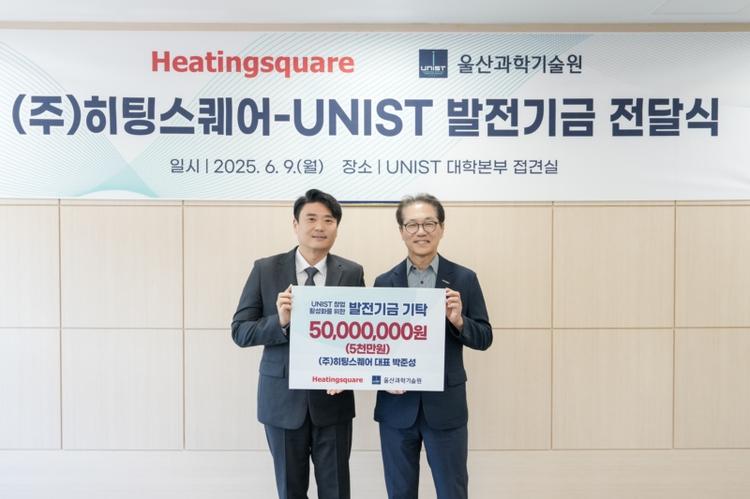
Heating Square Donates 50 Million KRW to Support UNIST Startup EcosystemThe donation ceremony took place at the Main Administration Building of UNIST on June 9, 2025.
UNIST has received a generous donation of 50 million KRW from Heating Square Co.,Ltd. on June 9, 2025. The funds will be dedicated to fostering startup activities and enhancing the entrepreneurial ecosystem at UNIST. The donation ceremony took place at the Main Administration Building of UNIST and was attended by President Joon Sung Park of Heating Square Co., Ltd., UNIST President Chong Rae Park, Director Woonggyu Jung of UNIST Development Fund Operation Division, Director Youngsik Kim of the Office of University and Industry Cooperation, and Director Tae Kyu Han of UNIST Holdings Co., Ltd. Founded in April 2024, Heating Square Co., Ltd. is Korea's only startup specializing in high-performance photolithography ceramic heater technology. The company filed a patent for its semiconductor photolithography ceramic heater in July of the same year. Furthermore, in November, it was selected for the Technology Incubator Program for Startup Growth (TIPS), receiving 700 million KRW in support, and has been rapidly advancing, gaining recognition for its innovative capabilities. President Chong Rae Park of UNIST expressed his appreciation, stating, "We sincerely thank Heating Square Co., Ltd. for their courageous decision during challenging times." He further noted, "The endowment will be actively utilized to nurture and support outstanding startups like Heating Square, further strengthening our startup ecosystem." President Park of Heating Square Co., Ltd. remarked, "I wanted to contribute to UNIST’s efforts in creating a startup-friendly environment in Ulsan. Heating Square aims to replace technological dependence on Japan and emerge as a company setting new industry standards, fostering innovation and growth."- 2025-06-09
- JooHyeon Heo
- 325
![[배성철칼럼]AI 시대 대학 교육 혁신에 대한 도전(1)](/app/board/attach/image/thumb_558002_1749603618000.do)
![[안현실칼럼]노바투스의 꿈, ‘산업현장을 AI 학교로’](/app/board/attach/image/thumb_558000_1749512283000.do)